Author Website SEO: 5 Quick Wins That Actually Move the Needle
SEO doesn't have to be complicated. These five changes take minutes and measurably improve how search engines find and rank your author website.
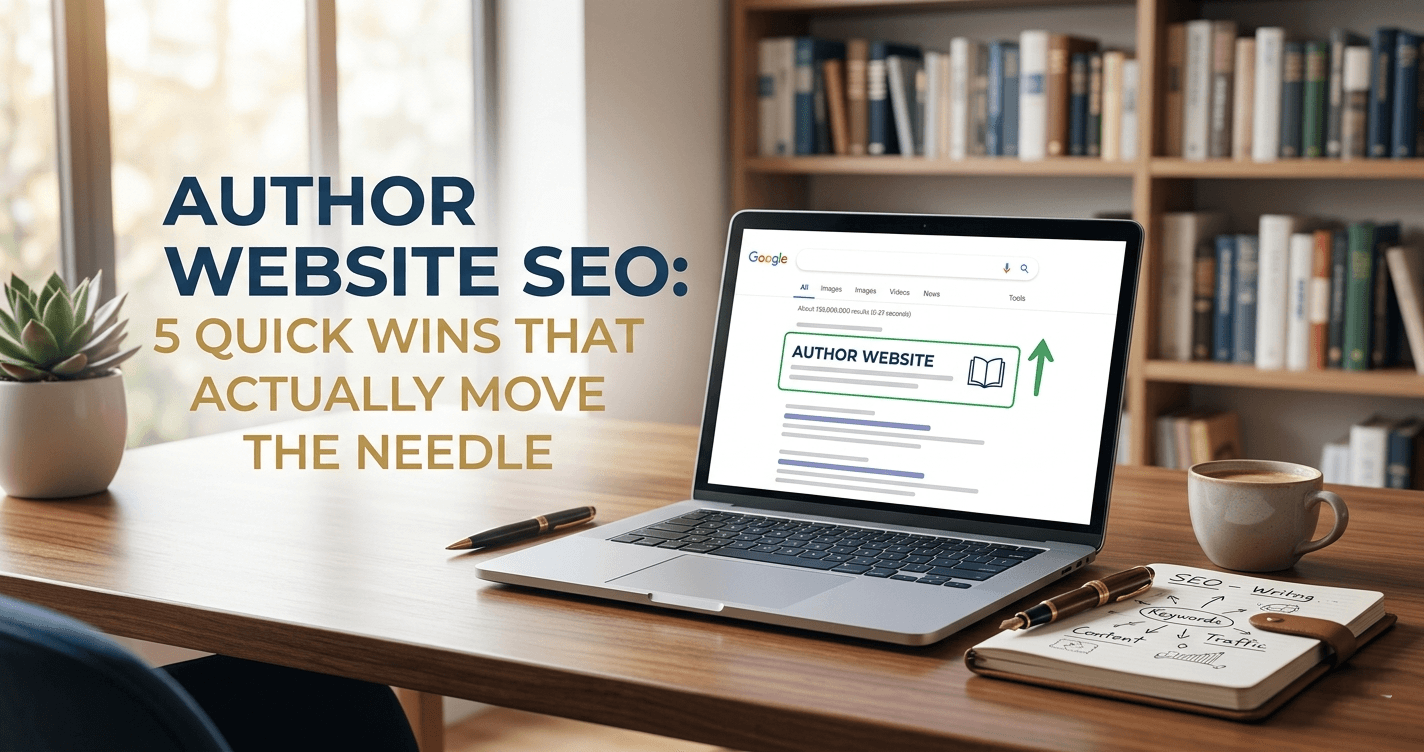
SEO sounds intimidating, but most of the value comes from a handful of basics that take minutes to implement. If your author website doesn't do these five things, you're invisible to search engines — and to the readers searching for books like yours.
1. Write a Real Meta Description for Every Book Page
The meta description is the snippet that shows up in Google results. If you leave it blank, Google picks random text from your page — usually not the most compelling pitch. Write a 150-character description that makes a reader want to click.
2. Use Your Book Title in the Page Title
Your page title (the text in the browser tab) should include the book title and your author name. "The Shadow Gate by Jane Smith" beats "Book Page" every time. AuthorLoft does this automatically.
3. Add Alt Text to Your Book Covers
Every image on your site should have alt text — a short description of what the image shows. For book covers: "Cover of The Shadow Gate by Jane Smith — a dark fantasy novel." This helps search engines understand your images and improves accessibility.
4. Blog Regularly With Relevant Keywords
Search engines reward fresh, relevant content. A blog post every 2–4 weeks about topics your readers care about drives long-tail traffic. Write about your genre, your writing process, or themes in your books. Each post is a new entry point for search traffic.
5. Get Your Structured Data Right
Structured data (Schema.org markup) tells search engines exactly what your pages contain — book details, reviews, ratings, author information. With proper structured data, your book pages can show star ratings and pricing directly in search results. AuthorLoft adds this automatically to every page.
Bonus: Check Your Site Speed
Google penalizes slow sites. If your author website takes more than 3 seconds to load, you're losing both readers and rankings. Use Google PageSpeed Insights to check. Hosted platforms like AuthorLoft are optimized for speed out of the box.
Author Website SEO: The Complete Guide to Being Found by Readers
How to make your author website discoverable, searchable, and visible — even if SEO intimidates you
Introduction: SEO Isn’t Complicated — It’s Consistency
Most authors think SEO is a technical, mysterious, code‑heavy discipline reserved for marketers and web developers. In reality, 80% of SEO success comes from a handful of simple habits that take minutes to implement and pay dividends for years.
Your author website is your digital home. It’s where readers discover your books, join your email list, and learn about you. But none of that matters if readers can’t find you in the first place.
If your website doesn’t follow the five fundamentals in this guide, you’re effectively invisible to:
Readers searching for books like yours
Bloggers and reviewers looking for author info
Journalists researching your genre
Librarians and booksellers
Podcast hosts and event organizers
SEO is not about tricking Google.
SEO is about helping search engines understand who you are, what you write, and why your site matters.
This guide breaks down the five essential SEO practices every author website must implement — and shows you exactly how to do it.
1. Write a Real Meta Description for Every Book Page
Your meta description is your first impression in Google — make it count.
When someone searches for your book title, your name, or your genre, Google displays a small snippet of text under your page title. That snippet is called the meta description.
If you don’t write one, Google grabs random text from your page — often the first sentence of your bio, a copyright notice, or a line from your footer. None of these help you sell your book.
Why meta descriptions matter
They influence whether someone clicks your link
They help Google understand your page
They improve your search ranking for relevant keywords
They allow you to pitch your book in one sentence
A good meta description increases click‑through rate (CTR), which is one of Google’s strongest ranking signals.
How to write a strong meta description
Your meta description should be:
150–160 characters
Compelling
Genre‑specific
Keyword‑rich
Written for humans, not robots
Formula for a perfect meta description
[Book Title] is a [genre] novel about [core hook]. Perfect for fans of [comparison authors].
Examples
Fantasy:
“The Shadow Gate is a dark fantasy novel about a reluctant mage facing an ancient evil. Perfect for fans of Brandon Sanderson and V.E. Schwab.”
Romance:
“Falling for the Enemy is a slow‑burn enemies‑to‑lovers romance with heart, heat, and humor. Ideal for fans of Emily Henry.”
Thriller:
“Dead Line is a fast‑paced psychological thriller where every clue leads to danger. A must‑read for fans of Gillian Flynn.”
Where to add meta descriptions
Your homepage
Every book page
Your blog posts
Your About page
Your contact/media page
AuthorLoft advantage
AuthorLoft includes built‑in fields for meta descriptions on every page, ensuring you never forget this crucial SEO step.
2. Use Your Book Title in the Page Title
Your page title is the most important SEO element on your entire site.
The page title (also called the title tag) is the text that appears:
In the browser tab
In Google search results
In social media previews
If your page title is something generic like “Book Page,” “My Novel,” or “New Release,” you’re missing the single strongest SEO signal available.
Your page title must include:
Your book title
Your author name
Optional: your genre
Examples of strong page titles
The Shadow Gate by Jane Smith | Dark Fantasy Novel
Falling for the Enemy — A Romance Novel by Jane Smith
Dead Line | Psychological Thriller by Jane Smith
Why this matters
Search engines use page titles to determine:
What your page is about
Whether it matches a user’s search
How to categorize your content
If someone searches for your book title, your page title should match exactly.
Common mistakes to avoid
Using the same title for multiple pages
Leaving the default title (“Home,” “Books,” “Page 1”)
Using vague titles (“My Writing,” “Latest Release”)
Forgetting to include your author name
AuthorLoft advantage
AuthorLoft automatically formats your page titles using best practices, ensuring every book page is optimized without extra work.
3. Add Alt Text to Your Book Covers
Alt text improves SEO, accessibility, and discoverability — all in one step.
Alt text (alternative text) is a short description attached to an image. It serves two purposes:
Accessibility: Screen readers use alt text to describe images to visually impaired users.
SEO: Search engines use alt text to understand what an image represents.
If your book cover has no alt text, Google has no idea what the image is — and you miss out on ranking in Google Images and book‑related searches.
How to write alt text for book covers
Your alt text should include:
The book title
Your author name
The genre
A brief visual description
Examples
“Cover of The Shadow Gate by Jane Smith — a dark fantasy novel featuring a glowing portal.”
“Cover of Falling for the Enemy by Jane Smith — a contemporary romance with a couple on a beach.”
“Cover of Dead Line by Jane Smith — a psychological thriller with red typography on a black background.”
Where to add alt text
Book covers
Author headshots
Blog post images
Promotional graphics
Series banners
SEO benefits
Helps Google index your images
Improves ranking for book title searches
Boosts accessibility (which Google rewards)
Enhances your site’s overall quality score
AuthorLoft advantage
AuthorLoft prompts you to add alt text to every image, ensuring your site meets accessibility and SEO standards.
4. Blog Regularly With Relevant Keywords
Blogging is the most powerful long‑term SEO strategy for authors.
Search engines reward websites that publish:
Fresh content
Relevant content
Keyword‑rich content
Helpful content
A blog post every 2–4 weeks is enough to build long‑term search traffic.
Why blogging works
Every blog post is a new page Google can index.
Every page is a new opportunity to rank.
Every ranking brings new readers.
Blogging creates long‑tail traffic — visitors who find you through specific, niche searches like:
“best cozy mystery settings”
“how to write a fantasy villain”
“books like The Night Circus”
“slow burn romance recommendations”
These visitors are highly targeted and more likely to become fans.
What to blog about
1. Your genre
Tropes
Themes
Worldbuilding
Character archetypes
Genre history
2. Your writing process
How you outline
How you revise
How you build characters
Behind‑the‑scenes of your books
3. Your books
Deleted scenes
Character deep dives
World lore
Inspiration posts
4. Reader‑focused content
Reading lists
Book recommendations
Genre explainers
Fan Q&A
5. Search‑friendly topics
Use tools like Google Autocomplete or AnswerThePublic to find questions readers are already asking.
Examples:
“What is cozy fantasy?”
“How long should a romance novel be?”
“What makes a good thriller ending?”
How to optimize each blog post
1. Use a keyword in the title
Example:
“How to Write a Slow‑Burn Romance That Keeps Readers Hooked”
2. Use the keyword in the first paragraph
Google scans early text for relevance.
3. Add subheadings
Break up your content with H2 and H3 headers.
4. Add internal links
Link to:
Your books
Your About page
Other blog posts
5. Add external links
Google rewards sites that cite reputable sources.
6. Add images with alt text
This improves both SEO and readability.
7. End with a call‑to‑action
Examples:
“Read my latest book.”
“Join my newsletter for updates.”
“Download my free prequel.”
5. Get Your Structured Data Right
Structured data is the secret weapon that makes your books stand out in search results.
Structured data (also called Schema.org markup) is a special type of code that tells search engines exactly what your page contains.
Without structured data, Google has to guess.
With structured data, Google knows:
Your book title
Your author name
Your book description
Your cover image
Your genre
Your ISBN
Your reviews
Your star ratings
Your pricing
Your publication date
This allows Google to display rich results — enhanced search listings that include:
Star ratings
Pricing
Availability
Book cover thumbnails
Review counts
Rich results dramatically increase click‑through rate.
Why structured data matters
Helps Google index your books correctly
Improves your ranking for book‑related searches
Makes your search results more attractive
Boosts credibility and professionalism
Helps readers find your books faster
Types of structured data authors need
Book schema (for each book page)
Author schema (for your About page)
Breadcrumb schema (for navigation)
Article schema (for blog posts)
Product schema (if selling direct)
AuthorLoft advantage
AuthorLoft automatically adds structured data to:
Book pages
Author pages
Blog posts
Store pages
No coding required. No plugins. No technical setup.
Putting It All Together: Your Author Website SEO Checklist
For every book page
[ ] Custom meta description
[ ] Page title includes book title + author name
[ ] Alt text on book cover
[ ] Structured data enabled
[ ] Internal links to related books
[ ] External links (optional)
[ ] Clear call‑to‑action
For your homepage
[ ] Clear headline with your genre
[ ] Featured book section
[ ] Email signup form
[ ] Meta description
[ ] Structured data
For your blog
[ ] Keyword‑rich titles
[ ] Regular posting schedule
[ ] Internal links
[ ] Alt text on images
[ ] Meta descriptions
[ ] Article schema
For your images
[ ] Alt text on every image
[ ] Descriptive, keyword‑rich phrasing
[ ] Genre‑specific language
For your overall site
[ ] Fast loading speed
[ ] Mobile‑friendly design
[ ] Secure (HTTPS)
[ ] Clear navigation
[ ] Consistent branding
Conclusion: SEO Is Simpler Than You Think — And More Important Than You Realize
SEO isn’t about gaming the system.
It’s about clarity, consistency, and communication.
When your author website:
Has real meta descriptions
Uses proper page titles
Includes alt text
Publishes regular blog content
Implements structured data
…you become discoverable.
Readers searching for books like yours can finally find you.
Reviewers and bloggers can verify your information.
Search engines can understand your content.
Your books can appear in rich results with star ratings and covers.
Your website becomes a long‑term asset that grows your audience automatically.
And the best part?
Most of this takes minutes — not hours — to implement.
Related reading: Author SEO Explained
· Ready to start your business? ·
Own your author business starting today
Keep 100% of every sale and own every reader relationship — no middleman.
Get Started Free