AuthorLoft - Not Just an Author Website
Most author websites do one thing: they exist. They have a bio, a list of books, maybe a contact form, and a link that sends readers off to Amazon to buy. The author never sees who clicked, never captures an email address, and never touches a cent of that sale directly. The website works — technically — but it works for the retailer, not the author.
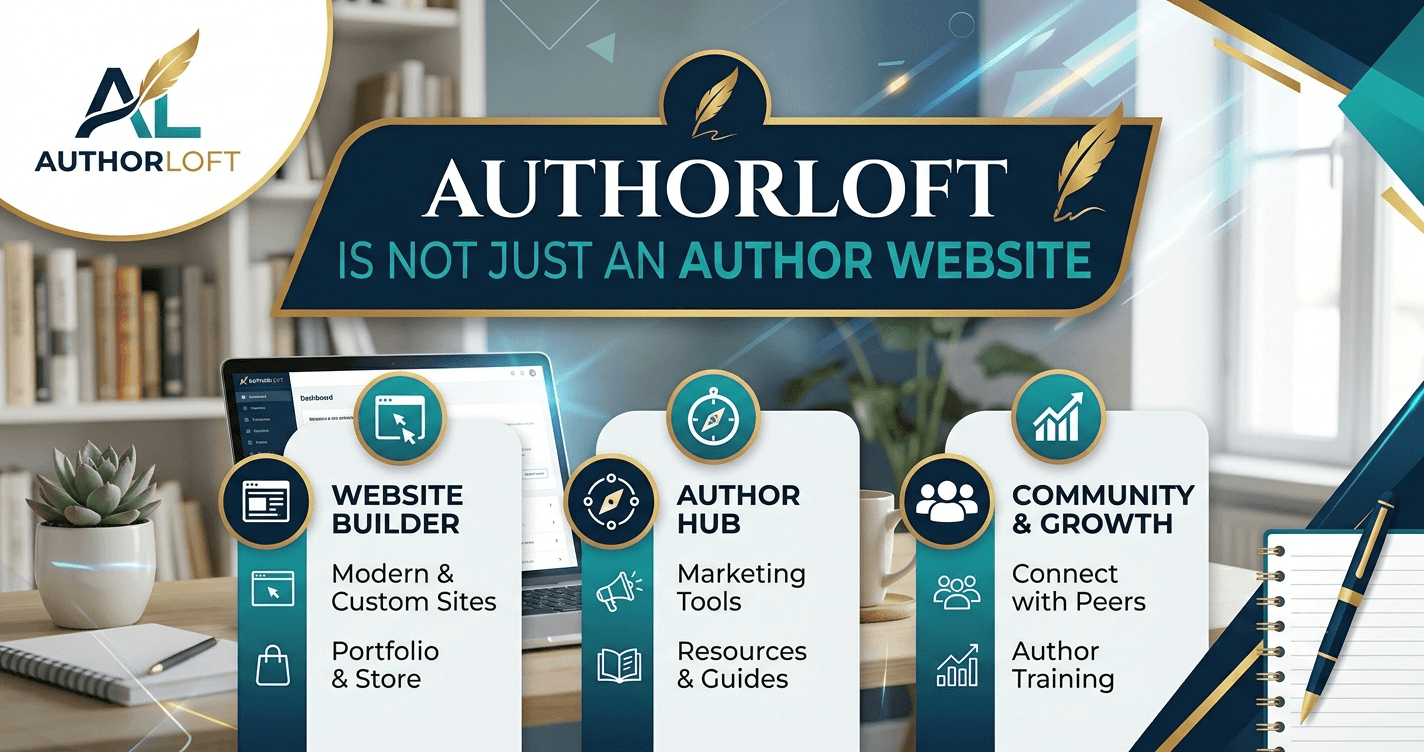
AuthorLoft Is Not Just an Author Website — And That Distinction Matters
Most author websites do one thing: they exist. They have a bio, a list of books, maybe a contact form, and a link that sends readers off to Amazon to buy. The author never sees who clicked, never captures an email address, and never touches a cent of that sale directly. The website works — technically — but it works for the retailer, not the author.
AuthorLoft was built with a different premise entirely. It is an author platform, not an author website. The distinction is not marketing language. It is a structural difference in what the tool does, who holds the data, and where the money goes.
The Problem With "Just a Website"
A traditional author website is a brochure. It presents information and then passes the reader somewhere else — usually a major retailer — to complete the transaction. At that point, the author is out of the picture. The reader is the retailer's customer, not the author's. The purchase history lives in the retailer's system. The email address goes into their list, not yours. And the revenue is split on terms the author did not negotiate and cannot change.
This is not a criticism of any particular retailer. It is simply how the model works. The challenge is that many authors accept this as the only way things can work, when it is not.
AuthorLoft makes the alternative practical. Everything an author needs to operate as an independent business — a website, direct sales, email marketing, analytics, media assets, and AI content tools — lives in one platform. The author owns the output. The readers belong to the author, not an intermediary.
Direct Sales: Where the Revenue Model Changes
The most concrete difference between AuthorLoft and a standard author website is direct sales. When a reader buys a book through an author's AuthorLoft storefront, the transaction runs through Stripe — the author's own Stripe account. The money goes directly to them. AuthorLoft does not take a platform cut.
This is worth pausing on. A typical retail arrangement sees 30 to 65 percent of revenue stay with the retailer, depending on the platform and format. On AuthorLoft, the author keeps 100 percent of the sale price, minus Stripe's standard processing fee. For an author selling a ten-dollar ebook, the difference between a 35 percent retail royalty and a 97 percent direct sale is significant, especially at volume.
The platform supports multiple formats — ebooks, print books, audiobooks, and flipbook previews — depending on the plan. Authors can also set up pre-order pages with countdown timers and automatic notification emails when a book goes live. Discount codes, affiliate links, and a built-in shopping cart for multi-book orders are all included on Standard and Premium plans. These are not features that require third-party plugins or separate accounts. They are part of the platform.
The Email List You Actually Own
Every marketer will tell you the same thing: the email list is the asset. Social media reach is borrowed. Algorithm changes can wipe out an audience overnight. An email list, hosted on infrastructure you control, cannot be taken away by a platform policy update.
Most author websites capture email addresses through a form that feeds into a third-party tool — Mailchimp, ConvertKit, or similar. The author has to manage that separately, pay for it separately, and make sure it stays connected to whatever else they are running. AuthorLoft integrates this natively. Newsletter signup forms, reader magnet delivery (where a free download is offered in exchange for an email), full campaign creation, and list management are built into the platform.
For authors on Standard and Premium plans, email campaigns can be sent directly from the dashboard. There is no separate subscription required. The reader's email address stays in the author's account. If an author decides to export their list and move it somewhere else, they can — because it is their data, not the platform's.
Reader Analytics: Knowing Who Is Actually Reading
A static author website typically gives you traffic numbers from Google Analytics, if the author has bothered to set it up. You can see how many people visited a page. You cannot see which books are getting the most attention, where readers are dropping off, or what content is driving purchases.
AuthorLoft Premium includes reader analytics powered by PostHog. This means authors can track page views, book page popularity, traffic sources, and reader behavior patterns — all within the dashboard. For an author managing multiple titles and trying to figure out where to focus their marketing effort, this is genuinely useful data. It removes the guesswork from decisions that would otherwise be made on instinct.
This is not a feature that makes sense to describe in detail without seeing the dashboard in practice. The point is that it exists, it is included in the top-tier plan, and it is the kind of tool that separates a business operating on information from one operating in the dark.
AI Tools That Are Actually Relevant to Authors
The AI tools in AuthorLoft are not generic content generators. They are scoped to the specific tasks an author faces: writing book descriptions that sell, drafting blog content, generating social media posts for a launch, and auditing SEO performance on their site.
The book description generator is the most immediately practical. Writing a compelling back-cover blurb is one of the hardest parts of self-publishing for many authors. The tool takes the book's details and generates blurb options the author can refine. It does not replace the author's judgment — it gives them something to work with rather than a blank page.
The SEO audit tool, available on Premium, analyses the author's site for keyword density, meta tags, and internal linking. This matters because discoverability through search is a real factor for authors, particularly for non-fiction and genre fiction where readers actively search for specific topics. A site that ranks well on a search query does not need to spend as much on advertising to reach new readers.
There is also a social media post generator (Social Promote) that drafts platform-specific posts — for Facebook, Instagram, X, Reddit, Threads, Bluesky, and on Premium, LinkedIn and TikTok — in 14 different promotional formats, from launch announcements to behind-the-scenes content. The author controls the brand tone and voice. The tool handles the structural work of formatting for each platform.
ARC Management and the Pre-Launch Machine
Advance reader copies — ARCs — are how authors build early reviews before a book goes live. Managing an ARC program manually, through email and spreadsheets, is time-consuming and prone to slipping through the cracks.
AuthorLoft includes built-in ARC management on Standard and Premium plans. Authors can distribute review copies, track who has received them, and collect reader reviews that can then be displayed on their book pages. This is not a separate tool the author has to source and pay for independently. It is part of the same dashboard where they manage everything else.
Combined with pre-order pages and countdown timers, AuthorLoft gives authors a structured way to build momentum before a release date — capturing email addresses, collecting early reviews, and creating a launch moment rather than a quiet drop into an already crowded market.
Media Kits and Professional Presence
When a podcast host, journalist, or event organiser wants to feature an author, they often ask for a media kit — a packaged document with the author's bio, headshot, book covers, and key talking points. Authors who do not have one ready typically scramble to put something together, or they lose the opportunity to someone who does.
AuthorLoft automatically generates a media kit from the author's profile information. On Standard and Premium plans, this kit can be downloaded as a PDF and shared directly. It is not a sophisticated design tool, but it does not need to be. It needs to be ready when someone asks for it, and it needs to look professional. AuthorLoft handles both.
What It Costs to Get Started
AuthorLoft's free plan is a functional starting point, not a teaser. Authors get a subdomain, up to five books, a newsletter signup form, a bookstore listing, and a contact form — at no cost, with no credit card required. For a first-time author or someone testing the platform before committing, that is a reasonable evaluation period.
The Standard plan is $19.99 per month and adds direct sales, a custom domain, newsletter campaigns, ARC management, and up to 25 books. The Premium plan is $59.99 per month and includes AI tools, the full analytics dashboard, audiobook and flipbook formats, and unlimited books and blog posts. Both paid plans offer a 20 percent discount on annual billing, and both come with a 30-day money-back guarantee.
The Case for Owning Your Platform
The argument for AuthorLoft is not that every author should abandon retail distribution. A book on Amazon still reaches a large audience, and that audience matters. The argument is that an author's own platform should be doing more than displaying information and pointing elsewhere.
If a reader visits an author's site and leaves without giving an email address, that reader may never come back. If a book sale happens through a retailer, the author has no record of who bought it. Over time, those missed connections add up. Building a direct relationship with readers — one the author controls, one that survives platform changes and algorithm updates — is a long-term asset.
AuthorLoft is a practical tool for building that asset. It is not the only way to do it, but it is one of the more complete single-platform solutions available for independent authors at this price point. For an author who is serious about treating their writing as a business, it is worth a close look.
AuthorLoft is available at authorloft.com. The free plan requires no credit card.
Related reading: What Is AuthorLoft?
· Ready to start your business? ·
Own your author business starting today
Keep 100% of every sale and own every reader relationship — no middleman.
Get Started Free