Which Social Media Platform Drives the Most Book Sales? (Use Data to Find Out)
Every author wonders which platform is "best." The answer is in your analytics — here's how to read the data and stop wasting time on platforms that don't convert.
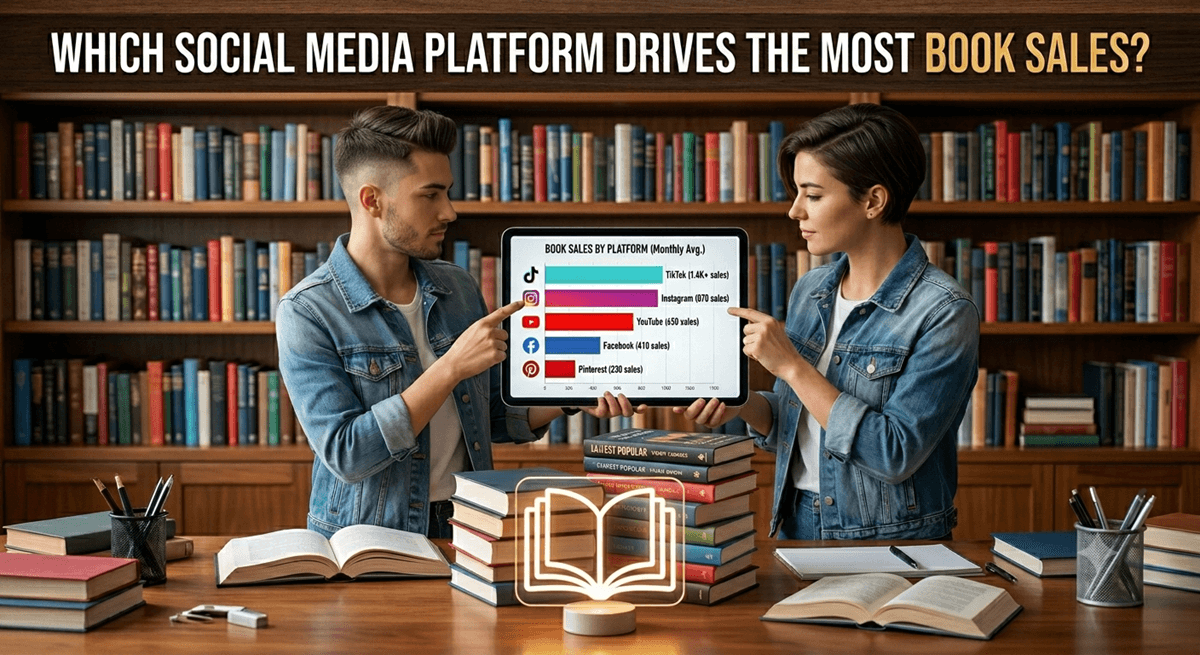
Authors constantly debate: Is BookTok better than Bookstagram? Should I be on Facebook or Twitter? The truth? It depends entirely on your audience. And the only way to know is to look at your data.
The Question Isn't "Which Platform Is Best"
It's "Which platform drives traffic to my website?" A platform with millions of users is worthless if none of them click through to your book page.
How to Find Your Answer
Check your traffic sources — Your website analytics show exactly which platforms send visitors. Look at the referral breakdown: Instagram, Facebook, Twitter/X, Pinterest, TikTok, etc.
Compare traffic to conversions — A platform that sends 500 visitors who bounce is less valuable than one that sends 50 visitors who subscribe or buy.
Track campaign results — When you post on Instagram vs. Twitter, which drives more clicks? Run the same promo on both and compare.
What the Data Usually Shows
While every author is different, common patterns emerge:
Pinterest — Often the surprise winner for author websites. Pins have a long shelf life and drive consistent, interest-targeted traffic.
TikTok / BookTok — High engagement and discovery potential, but traffic is spiky (viral hits) rather than steady.
Instagram — Strong for brand building and community, but Instagram makes it hard to drive link clicks (link in bio only).
Facebook — Best for established authors with active groups. Organic reach has declined significantly.
Newsletter — Technically not social media, but almost always the highest-converting traffic source for sales.
The Actionable Takeaway
Spend your time where your data says your readers are — not where publishing Twitter says they should be. Check your analytics monthly and adjust your strategy quarterly.
Stop Guessing Your Best Platform : A Data‑Driven Guide for Authors Who Want Real Results
Authors spend an extraordinary amount of time debating which social platform is “best.” Is BookTok still king? Is Bookstagram more reliable? Should you bother with Facebook? Is Twitter/X even worth touching anymore?
These conversations happen in writing groups, Discord servers, Facebook communities, and conference panels. And while they’re fun to talk about, they’re built on a false premise.
Because the truth is simple:
There is no universally best platform.
There is only the platform that works for your audience.
And the only way to know which platform that is?
Not vibes. Not trends. Not what other authors swear by.
Your data.
Everything else is noise.
The Real Question Isn’t “Which Platform Is Best?”
Most authors ask the wrong question. They want to know which platform has the most users, the most engagement, or the most hype. But none of that matters if those users never leave the app.
The real question — the only question that matters — is:
Which platform drives traffic to your website?
A platform with millions of active users is worthless if none of them click through to your book page, your newsletter signup, or your shop.
Likes don’t pay your bills.
Shares don’t grow your email list.
Comments don’t sell your book.
Clicks do.
And clicks come from understanding your traffic sources.
How to Find Your Answer (It’s Already in Your Analytics)
Most authors don’t need more social media.
They need more clarity.
Your website analytics already contain the truth about where your readers come from, how they behave, and which platforms actually matter. Here’s how to read that data in a way that leads to better decisions — and better results.
1. Check Your Traffic Sources
Your analytics dashboard (Google Analytics, Fathom, Plausible, or your website builder’s built‑in stats) shows exactly where your visitors originate.
Look specifically at your referral traffic — the list of platforms sending people to your site.
You’ll see sources like:
Instagram
Facebook
Twitter/X
Pinterest
TikTok / BookTok
YouTube
Reddit
Goodreads
Direct (people typing your URL or clicking from email)
This list is your reality check.
If you spend 10 hours a week on Instagram but it sends you 12 visitors a month, that’s not a strategy — that’s a time sink.
If Pinterest sends you 300 visitors a month even though you barely use it, that’s a signal.
If TikTok sends you traffic only when a video goes viral, that’s a pattern.
Your traffic sources tell you where your readers actually are — not where you hope they are.
2. Compare Traffic to Conversions
Traffic alone doesn’t tell the whole story.
You also need to know what those visitors do once they arrive.
A platform that sends 500 visitors who bounce in under 10 seconds is less valuable than one that sends 50 visitors who subscribe to your newsletter.
Look at:
Bounce rate — Do visitors leave immediately?
Time on page — Are they reading your content?
Pages per session — Are they exploring your site?
Email signups — Are they joining your list?
Book sales or retailer clicks — Are they buying?
This is where authors often get surprised.
Sometimes the platform with the least traffic has the highest conversions.
Sometimes the platform with the most engagement sends the worst traffic.
For example:
Instagram might send 200 visitors with a 90% bounce rate.
Pinterest might send 40 visitors with a 20% bounce rate and 10 email signups.
Which one is more valuable?
Pinterest — by a mile.
Conversions reveal the quality of your audience, not just the quantity.
3. Track Campaign Results (A/B Testing for Authors)
If you want to know which platform performs better, test it.
Post the same content — same copy, same CTA, same link — on two platforms and compare the results.
Examples:
A book teaser on Instagram vs. Twitter/X
A character aesthetic board on Pinterest vs. TikTok
A newsletter signup CTA on Facebook vs. Instagram Stories
A book sale announcement on TikTok vs. YouTube Shorts
Track:
Clicks
Traffic
Conversions
Engagement
Saves or shares
You’ll quickly see which platform moves people from “interested” to “taking action.”
This is how you stop guessing and start optimizing.
What the Data Usually Shows (Across Thousands of Authors)
Every author’s audience is unique — genre, age group, reading habits, and platform culture all play a role. But across the industry, certain patterns appear again and again.
Here’s what most authors discover when they look at their analytics.
Pinterest — The Quiet Powerhouse
Pinterest is often the surprise winner for author websites.
Why?
Pins have a long shelf life — months or even years.
Pinterest is a search engine, not a social network.
Users come with intent — they’re actively looking for ideas, books, and inspiration.
Traffic is consistent, not dependent on virality.
Authors who post:
Aesthetic boards
Writing tips
Book quotes
Character art
Mood boards
Blog posts
Book covers
…often see steady, reliable traffic that outperforms every other platform.
Pinterest is especially strong for:
Romance
Fantasy
YA
Cozy mystery
Historical fiction
Nonfiction with visual appeal (self‑help, lifestyle, wellness)
If you’ve ignored Pinterest, your analytics might surprise you.
TikTok / BookTok — High Engagement, Spiky Traffic
TikTok is unmatched for discovery.
It’s where books go viral.
It’s where unknown authors become bestsellers overnight.
But the traffic pattern is unpredictable.
You’ll see:
Huge spikes when a video hits
Quiet periods between viral moments
High engagement but inconsistent click‑throughs
Strong brand awareness but weaker website traffic
TikTok is phenomenal for:
Building visibility
Reaching new readers
Creating emotional connection
Generating buzz
But it’s not always the best for driving steady, reliable website traffic.
Think of TikTok as your awareness engine, not your conversion engine.
Instagram — Great for Community, Weak for Clicks
Instagram is beautiful, polished, and community‑driven.
It’s where authors build relationships, share aesthetics, and connect with readers.
But Instagram has one major flaw:
It does not want users to leave the app.
Link clicks are limited to:
Link in bio
Link stickers in Stories
Paid ads
This means:
Engagement is high
Traffic is low
Conversions are inconsistent
Instagram is excellent for:
Brand building
Reader connection
Visual storytelling
Behind‑the‑scenes content
Community engagement
But if your goal is website traffic, Instagram rarely tops the list.
Facebook — Strong for Established Authors, Weak for Discovery
Facebook’s organic reach has declined dramatically over the years.
But it still has strengths — especially for authors with an existing audience.
Facebook works well for:
Active reader groups
Book clubs
Older demographics
Long‑form posts
Community discussions
It’s less effective for:
Reaching new readers
Driving organic traffic
Younger audiences
If you already have a loyal fan base, Facebook can be powerful.
If you’re starting from scratch, it’s a slow climb.
Newsletter — Your Highest‑Converting Channel
Your newsletter is not social media, but it is almost always your top‑performing traffic and sales source.
Email subscribers:
Click more
Buy more
Engage more
Stay longer
Convert at higher rates
Your newsletter is the only platform you truly own.
It’s the only audience you control.
It’s the only channel that isn’t at the mercy of algorithms.
If you want reliable traffic and predictable sales, your newsletter is your foundation.
Everything else is a funnel leading toward it.
The Actionable Takeaway: Follow Your Data, Not the Noise
Stop guessing.
Stop chasing trends.
Stop letting other authors’ opinions dictate your strategy.
Your analytics already tell you:
Where your readers are
What they click
What they ignore
What converts
What wastes your time
A simple system keeps you aligned:
Check your analytics monthly
Review your platform performance quarterly
Invest more time in the platforms that send traffic
Reduce or eliminate time spent on platforms that don’t
Treat your newsletter as your core conversion engine
Your audience will show you exactly where to show up — if you’re willing to look at the numbers.
Related reading: Book Advertising for Authors
· Ready to start your business? ·
Own your author business starting today
Keep 100% of every sale and own every reader relationship — no middleman.
Get Started Free