Why Authors Are Leaving Amazon KDP for Direct Sales
A growing number of indie authors are reducing their Amazon dependency. We spoke to authors who made the switch — here's what they said.
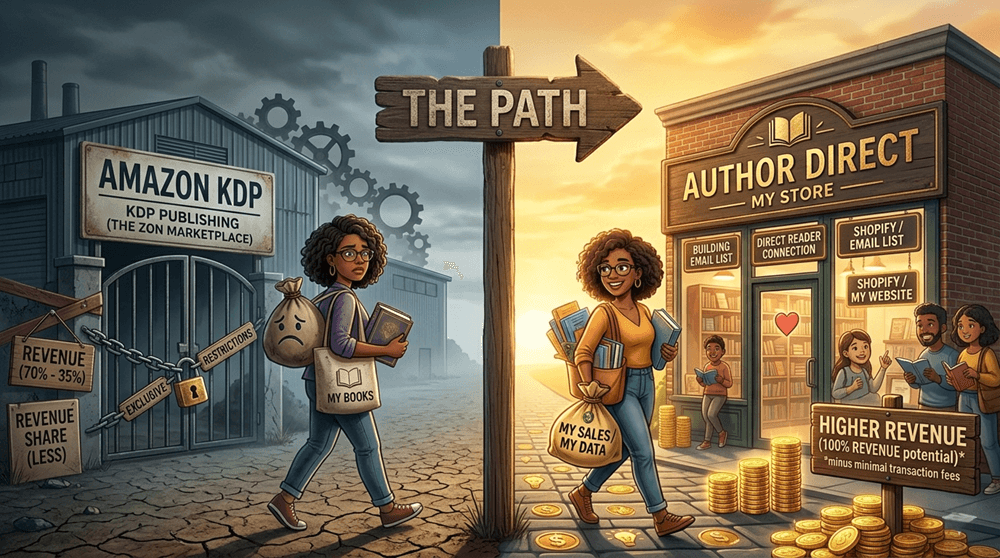
Something Is Shifting in Independent Publishing
For more than a decade, Amazon KDP was the default infrastructure of indie publishing. Authors uploaded their manuscripts, set their prices, and let Amazon's algorithm do the distribution work. For many, it worked well enough. For a growing number, it no longer does.
Across author communities, forums, and podcasts, a consistent pattern has emerged: experienced indie authors — particularly those with established backlists and loyal readerships — are deliberately reducing their Amazon dependency. Some are going fully direct. Others are adopting a hybrid model that treats Amazon as one channel among several rather than the foundation of their entire business.
This is not a fringe movement. It is a structural shift in how successful independent authors think about their businesses. Here is what is driving it.
The Algorithm Problem
Amazon's recommendation algorithm is the engine of KDP discoverability. When it works in your favour, it can put your book in front of thousands of potential readers at minimal cost. When it does not — or when Amazon changes how it works — the results can be devastating.
Authors who built their entire income around Amazon rankings have watched years of ranking momentum disappear overnight. Category changes, tweaks to also-bought algorithms, shifts in how KDP Select titles are promoted — these decisions are made entirely within Amazon, communicated poorly, and impossible to predict or prepare for.
Authors leaving Amazon KDP direct sales behind as their primary strategy often cite this unpredictability as the pivotal moment. When your entire income depends on a single company's internal decisions, your business is not yours — it is theirs.
The Data Problem
Every author who has sold through Amazon knows the frustration: you can see how many copies you sold, but you have no idea who bought them. No names. No email addresses. No way to reach those readers again unless they happen to leave a review or follow your author page.
For authors who understand that their email list is their most valuable long-term asset, this is not a minor inconvenience — it is a fundamental flaw in the platform. Every sale on Amazon is a sale that builds Amazon's customer database, not yours.
Authors moving to direct sales report that the shift in how they think about their business is immediate. Suddenly, every sale is not just revenue — it is a reader relationship. A name. An email address. A person they can tell about their next book, their backlist, their limited edition. The compounding value of that list grows with every sale in a way that Amazon revenue simply does not.
The Exclusivity Problem
KDP Select — Amazon's programme that unlocks Kindle Unlimited and promotional tools — requires 90-day rolling exclusivity. Your eBook cannot be sold anywhere else while enrolled. For authors who want to sell directly to readers, maintain a presence on Kobo, or offer exclusive editions on their own website, this is a hard constraint.
Many authors describe the moment they realised what exclusivity was costing them as a turning point. Every direct sale they could have made, every Kobo reader they could have reached, every bundle they could have offered — all of it was off the table as long as they stayed in KDP Select.
Leaving Select does not mean leaving Amazon. Authors who go wide or move to direct sales typically keep their books on Amazon — they simply stop being exclusive. For most, the loss of Kindle Unlimited income is offset within months by the combination of direct sales margins, wide distribution royalties, and the growing value of their reader list.
The Margin Problem
At $4.99 in KDP, after Amazon's 30% cut and delivery fees, a typical author earns approximately $3.20 per sale. The same book sold directly at $4.99, after a 10% platform fee and payment processing, earns approximately $4.35 per sale. That is a 36% increase in earnings per copy — at identical pricing.
For authors selling hundreds or thousands of copies per month, this difference is significant. But the margin argument becomes even more compelling when you factor in the pricing freedom that direct sales unlock. Direct buyers — readers who have sought out your website specifically — are more price-tolerant than Amazon browsers. Authors routinely find that they can price their direct store 10 to 20 percent above their Amazon price with minimal impact on conversion rates.
The combination of higher per-sale margin and higher viable price points means that a single direct sale can be worth two to three times the income of an equivalent Amazon sale.
What the Transition Actually Looks Like
Authors who have made the shift from Amazon-dependent to direct-first describe a transition that is more gradual than dramatic. Most do not abandon Amazon entirely — they change how they think about it.
A common pattern: new releases go out on the author's own website first, available to newsletter subscribers at launch pricing for one or two weeks before appearing on Amazon and other retailers. This rewards the most loyal readers, generates direct sales at the highest margin during the critical launch window, and still feeds Amazon's algorithm with genuine sales data when the book goes wide.
Over time, as the author's newsletter list grows from direct buyer sign-ups, each new release generates more direct sales revenue at launch — reducing dependence on Amazon's promotional machinery and making the business more resilient overall.
The Tools Have Finally Caught Up
One reason the shift toward direct sales has accelerated in recent years is practical: the technology to do it well is now genuinely accessible to independent authors without technical expertise or large upfront investment.
Platforms like AuthorLoft give authors a complete author website with built-in eBook sales, automatic file delivery, Stripe payment processing, a blog for content marketing, and newsletter integration — without requiring authors to hire a developer or stitch together a dozen separate tools. Setting up a direct sales store that looks professional and handles the entire purchase and delivery workflow automatically takes hours, not weeks.
The friction that once made direct sales impractical for most indie authors has largely disappeared. What remains is a decision about priorities: do you want to keep building Amazon's business, or start building your own?
What Authors Say About Making the Switch
The authors who have moved to direct sales most consistently describe three changes to how their business feels:
First, a sense of ownership. They know who their readers are. They have a list they control. If Amazon disappeared tomorrow, their business would survive.
Second, a change in how they think about their back catalogue. Books that have faded on Amazon — too old to benefit from the launch algorithm, too niche to attract browse traffic — often perform consistently through direct channels because the readers finding them are looking specifically for what the author writes.
Third, a different relationship with their most loyal readers. When someone buys directly from an author's website, there is an implied relationship that does not exist in an Amazon transaction. Those buyers tend to engage more with newsletters, leave more reviews, and recommend the author more actively to friends.
Is Direct Sales Right for Every Author?
Direct sales work best for authors who already have some audience to direct toward their store — even a small newsletter, an active social following, or a backlist of readers who know their name. Without any existing traffic, a direct store will be quiet, at least initially.
For brand new authors with no audience, Amazon's built-in discovery remains valuable as a starting point. The strategic shift toward direct sales makes most sense once you have a foundation to build from.
But here is the thing: the best time to start building that direct sales foundation is before you need it. Every author who has made the shift wishes they had started collecting buyer email addresses earlier. The authors leaving Amazon KDP for direct sales today are not abandoning a working system — they are building a better one while they still have the luxury of time to do it thoughtfully.
The Direction of Travel Is Clear
Amazon will remain a significant part of the book market for the foreseeable future. It is too large, too convenient for readers, and too embedded in book-buying habits to be ignored. But it is no longer the only game in town for indie authors — and a growing number of experienced self-publishers are treating it that way.
The authors building the most resilient businesses in 2026 are the ones who see Amazon as a distribution channel rather than a business strategy. They sell on Amazon. They also sell everywhere else. And increasingly, the everywhere else — their own website, their own list, their own direct relationship with their readers — is where the real business lives.
Further Reading
· Ready to start your business? ·
Own your author business starting today
Keep 100% of every sale and own every reader relationship — no middleman.
Get Started Free