How to Build an Email List as an Author
Your email list is the one asset you own completely. Here's a practical guide to growing it from zero.
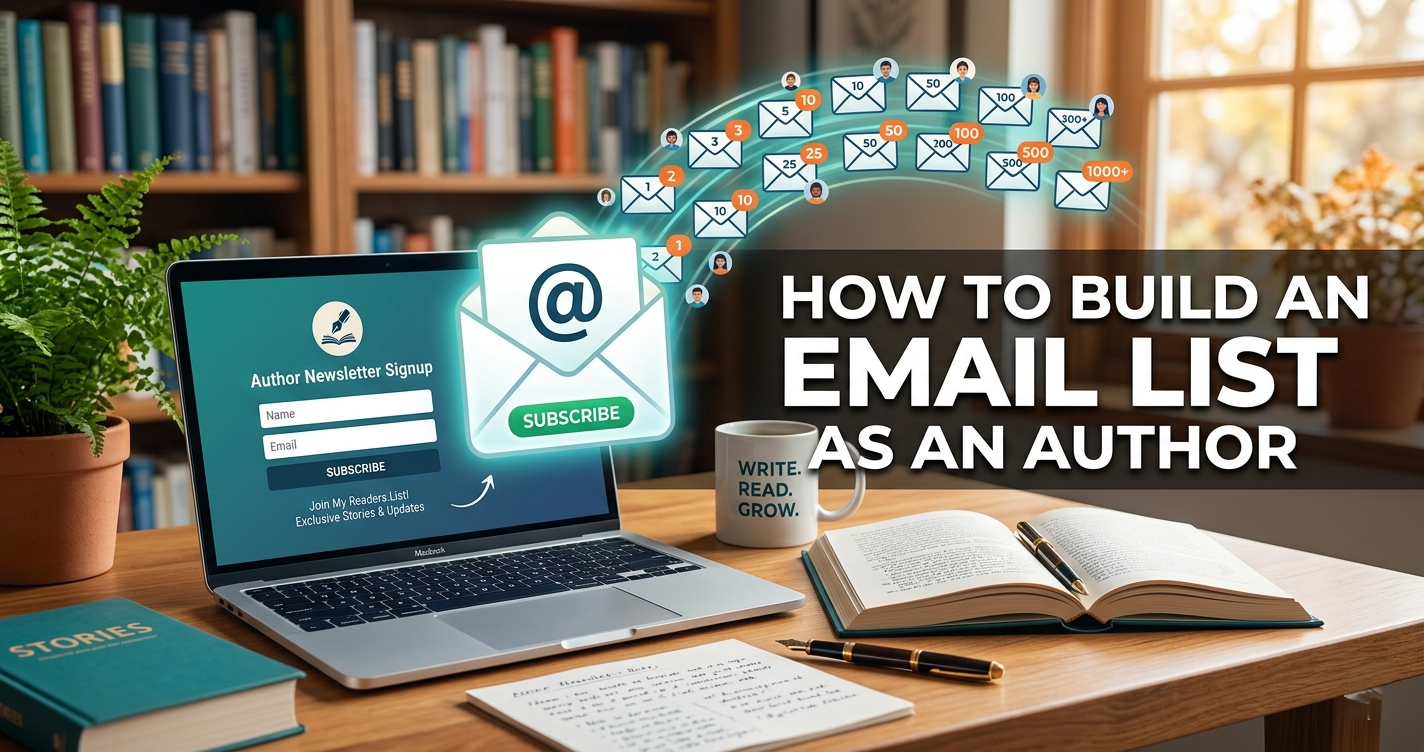
Your Email List Is the One Asset You Own Completely. Here’s a Practical Guide to Growing It From Zero
If you’re building a career as an author—fiction, nonfiction, children’s books, poetry, hybrid, or indie—there’s one asset more valuable than social media followers, algorithm luck, or even ad spend: your email list.
It’s the only audience you own.
It’s the only channel you can reach without permission from a platform.
And it’s the only marketing asset that compounds in value every single month.
But what if you’re starting from zero?
What if you don’t have a big following, a viral post, or a book launch yet?
Good news: you don’t need any of that.
Growing an email list is not about popularity. It’s about clarity, consistency, and connection. This guide walks you through the practical, realistic steps authors use to grow an email list from nothing—without feeling salesy, overwhelmed, or glued to social media.
Why Your Email List Matters More Than Anything Else
Before we get tactical, let’s get clear on why this matters so much.
Your email list is:
Algorithm‑proof — no platform can throttle your reach
Portable — you can take it anywhere, forever
High‑converting — email consistently outperforms social by 5–10x
Relationship‑driven — readers who join your list are raising their hand
Launch‑ready — every book launch becomes easier and more predictable
Social media is a megaphone.
Your email list is a living room conversation.
And in 2026, when AI‑generated content floods every feed, readers crave direct, human connection more than ever. Your newsletter becomes the place where your voice isn’t competing with noise.
Step 1: Create a Simple, Clear Value Offer
People don’t join email lists “just because.”
They join when there’s a clear reason.
Your job is to give them one.
Here are proven offers that work for authors:
A sample chapter
A bonus scene or epilogue
A character dossier or world‑building map
A short story or prequel
A reading guide or discussion questions
A behind‑the‑scenes look at your writing process
The key is specificity.
“Join my newsletter” is vague.
“Get the deleted scene readers begged me to release” is irresistible.
Why specificity works
Readers want to know exactly what they’re getting.
A clear offer reduces friction and increases signups.
Think of your reader magnet as the “first date” with your audience.
It should be short, satisfying, and representative of your writing style.
Step 2: Build a Landing Page That Converts
You don’t need a full website to start.
You need one clean, focused landing page with:
A strong headline
A short description of the value
A simple email form
A clear call to action
Avoid clutter. Avoid menus. Avoid distractions.
A landing page’s only job is to convert a visitor into a subscriber.
What a high‑converting landing page looks like
Headline: “Get the prequel short story readers say should’ve been a full novel.”
Subhead: “Join 2,000+ readers and get instant access.”
Button: “Send me the story.”
Common mistakes authors make
Too much text
Too many links
No clear offer
Asking for too much information (never ask for more than name + email)
A landing page is not a homepage.
It’s a conversion engine.
Step 3: Put Your Offer Everywhere (Without Feeling Pushy)
Growing from zero is about visibility, not pressure.
Here are low‑effort, high‑impact places to share your offer:
Your social media bios
The link in your Instagram/TikTok profile
The back of your book
Your email signature
Your Goodreads profile
Your Amazon Author Central page
Your website homepage
Your “About the Author” section
You’re not selling—you’re inviting.
The psychology behind this
People need to see something multiple times before taking action.
By placing your offer in natural, low‑pressure locations, you create gentle, repeated exposure.
This is how you grow from zero without hustling.
Step 4: Use Social Media as a Funnel, Not a Home
Social media is great for discovery.
Email is where the relationship happens.
Your goal isn’t to “go viral.”
Your goal is to consistently point people toward your signup page.
Here are simple content ideas that naturally lead to email growth:
Share a snippet of your bonus content
Post a teaser from your sample chapter
Show a screenshot of your welcome email
Talk about what subscribers get that others don’t
Share a behind‑the‑scenes moment
Why this works
People love exclusivity.
When you frame your newsletter as a “VIP space,” readers feel like they’re joining something special.
Step 5: Send a Great Welcome Email
Your welcome email is the moment someone decides:
“I’m glad I signed up”
or
“Unsubscribe.”
Make it warm, personal, and valuable.
A strong welcome email includes:
A thank‑you
Delivery of the promised freebie
A short intro about who you are
What readers can expect next
A simple question to encourage replies
Why replies matter
Email platforms reward engagement.
If readers reply to your first email, your future emails are less likely to land in spam.
Plus, replies build connection.
Readers who talk to you become loyal fans.
Step 6: Email Consistently (Even If It’s Once a Month)
Consistency beats frequency.
You don’t need to email weekly.
You don’t need to write essays.
You don’t need to be clever.
You just need to show up.
Here are easy newsletter formats authors love:
A short update on your writing
A behind‑the‑scenes moment
A book recommendation
A personal reflection
A snippet from your work‑in‑progress
The consistency myth
Many authors think they need to email constantly to stay relevant.
Not true.
Readers don’t want perfection—they want connection.
Step 7: Make It Easy for Subscribers to Share
Your readers are your best marketers.
Add a simple line at the bottom of your emails:
“Know someone who’d enjoy this? Forward it to them.”
Or include a shareable link:
“Invite a friend to join the list.”
Why this works
People trust recommendations from friends more than ads.
A single enthusiastic reader can bring in dozens of new subscribers.
The Truth About Growing From Zero
Most authors overestimate what they can do in a week
and underestimate what they can build in a year.
If you add:
1 subscriber a day → 365 in a year
3 subscribers a day → 1,095 in a year
10 subscribers a day → 3,650 in a year
Small numbers compound.
Your list becomes an asset that grows while you sleep.
Advanced Strategies (When You’re Ready)
Once you’ve mastered the basics, you can accelerate growth with:
Newsletter swaps with other authors
Participating in BookFunnel or StoryOrigin promos
Running low‑budget ads to your landing page
Creating multiple reader magnets
Segmenting your list by genre or interest
These aren’t required. They’re accelerators.
Final Thought: Start Today, Even If It’s Imperfect
You don’t need a big audience.
You don’t need a finished book.
You don’t need a perfect plan.
You just need:
A simple offer
A clean landing page
A consistent presence
A willingness to start small
Your email list is the one asset no one can take from you. Build it now, and it will support your entire author career for years to come.
Choosing the Right Email Marketing Platform
One decision that trips up many authors early on is choosing an email platform. The good news is that most reputable platforms will serve you well — the worst choice is not picking a bad platform, it is spending months deliberating instead of starting.
That said, a few considerations are worth thinking through before you commit.
MailerLite is widely regarded as the best starting point for authors. It offers a generous free tier (up to 1,000 subscribers), clean templates, simple automations, and a landing page builder — everything you need to get started without paying a penny. The interface is intuitive enough that most authors are sending their first welcome sequence within an afternoon.
ConvertKit (now Kit) was built with creators in mind and has strong author adoption. Its tagging and segmentation system is genuinely powerful once your list grows and you want to send targeted emails — for example, emailing only subscribers who have not yet bought a particular book. It is slightly more expensive than MailerLite but offers more sophisticated automation.
Mailchimp is the most recognised name in email marketing but has become increasingly bloated with features that most authors do not need. Its free tier has become less generous over the years, and many authors find themselves paying for complexity they never use.
Whichever platform you choose, the most important thing is that you actually use it. A perfectly configured ConvertKit account that sends nothing is worth less than a MailerLite account with a simple monthly newsletter going out consistently every four weeks.
Signs Your List Is Growing in the Right Direction
Raw subscriber numbers are a vanity metric without context. These are the signals that indicate your list is healthy and growing with the right readers:
Your open rate is above 30%. Industry averages hover around 20 to 25% for creator newsletters. Authors who build their lists through genuine reader magnets and clear value propositions consistently outperform this. If your open rate is strong, your brand promise and your actual content are aligned.
Subscribers reply to your emails. Replies are the highest-quality signal an email sender can receive. They indicate genuine engagement and also improve your deliverability score with email providers, helping your future emails land in the inbox rather than the promotions folder.
New subscribers find your older content. When someone joins your list and immediately clicks through to your archive or your back catalogue, your welcome sequence is working. They are not just subscribing — they are actively exploring. That is the reader relationship you are building toward.
Sales spike when you send emails. This is the ultimate measure of list health for authors. A modestly-sized, highly engaged list of 500 true readers will consistently outperform a bloated list of 5,000 disengaged subscribers when it comes to book sales. Size matters less than alignment between your promise and your readers' expectations.
Further Reading
· Ready to start your business? ·
Own your author business starting today
Keep 100% of every sale and own every reader relationship — no middleman.
Get Started Free