7 Things Every Author Website Needs
Most author websites are missing the basics. Here are the seven elements that turn visitors into subscribers and buyers.
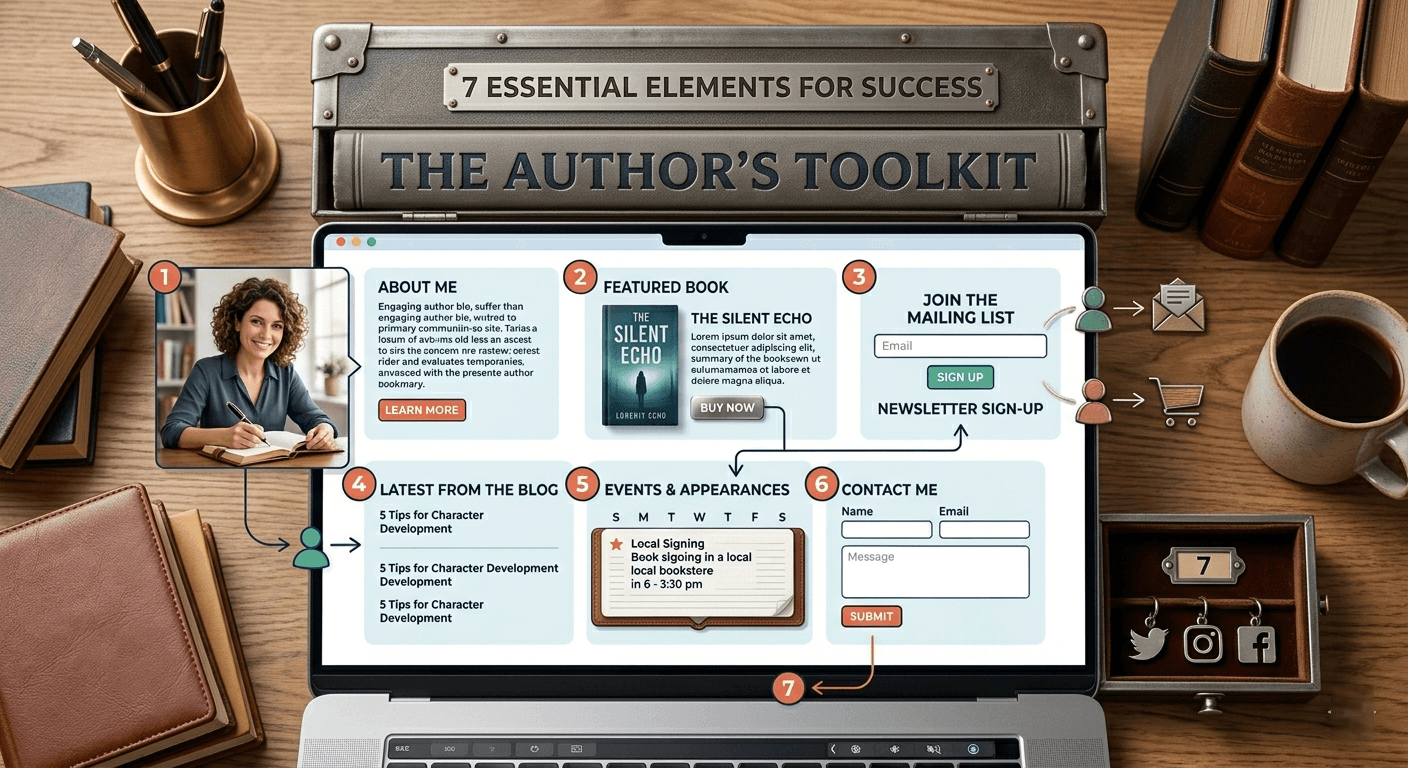
Most Author Websites Are Missing the Basics. Here Are the Seven Elements That Turn Visitors Into Subscribers and Buyers
Most author websites don’t fail because the author lacks talent, credibility, or a great book.
They fail because the site doesn’t do the one job it exists to do:
Turn a curious visitor into a subscriber or a buyer.
That’s it. That’s the whole purpose.
Yet most author websites—traditionally published, indie, hybrid, debut, or multi‑book—are built like digital business cards instead of conversion engines. They’re pretty, but they don’t work. They’re full of information, but not direction. They’re designed for browsing, not buying.
The good news?
You don’t need complicated funnels, expensive redesigns, or a dozen plugins.
You need seven foundational elements—the ones nearly every high‑performing author site has in common.
Below are the essentials, why they matter, and how to implement them with clarity and confidence.
1. A Clear, Reader‑Focused Value Proposition
Visitors decide in 3–5 seconds whether your site is relevant to them.
That’s not an exaggeration. It’s how fast the human brain filters information.
Most author sites open with vague taglines like:
“Welcome to my world”
“Author of fantasy novels”
“Stories that inspire”
These phrases sound poetic, but they don’t communicate value.
A strong value proposition tells readers:
What you write
Who it’s for
Why they should care
It’s not about you.
It’s about what your writing does for the reader.
Examples of strong value propositions
“Epic fantasy for readers who crave morally complex heroes.”
“Heartfelt Southern romance with small‑town charm and big emotional stakes.”
“Fast‑paced thrillers for fans who love clever twists and flawed protagonists.”
“Whimsical picture books that spark curiosity and bedtime giggles.”
Why this matters
Readers want to know instantly whether they’re in the right place.
A clear value proposition reduces cognitive load and increases engagement.
Where it goes
At the top of your homepage
Above the fold
In large, readable typography
Your value proposition is the handshake, the first impression, the “you belong here” moment.
2. A Prominent, Irresistible Email Signup
Your email list is your most valuable asset.
But most author sites bury the signup form in the footer or hide it behind a generic “Join my newsletter.”
Readers don’t join newsletters.
They join value.
Instead of offering nothing, offer something specific:
A free novella
A bonus epilogue
A character dossier
A behind‑the‑scenes world guide
A first‑chapter sampler
Where the signup belongs
Above the fold on your homepage
In your navigation (“Newsletter”)
At the bottom of your About page
On a dedicated landing page
In your footer
Why this matters
Email converts 5–10x better than social media.
It’s algorithm‑proof, platform‑proof, and future‑proof.
If your website doesn’t grow your list, it’s not doing its job.
3. A Book Page That Actually Sells
Most author book pages are just:
A cover
A short blurb
A few retailer buttons
That’s not a sales page.
That’s a placeholder.
Readers need more to make a buying decision.
A high‑converting book page includes:
A compelling hook or tagline
A polished description
Social proof (reviews, endorsements, awards)
A clear call‑to‑action
A clean, mobile‑optimized layout
Think of it as a mini‑sales page
Your book page should answer:
What is this book about?
Why should I care?
What makes it different?
What do other readers think?
Where can I buy it?
Optional enhancements
A short excerpt
A mood board
A book trailer
A “readers also enjoyed” section
A link to the series reading order
Your book page is not a formality.
It’s a revenue generator.
4. A Professional, Trust‑Building About Page
Readers don’t just buy books—they buy authors.
Your About page is often the second‑most visited page on your site.
Yet most authors treat it like an afterthought.
A strong About page includes:
A warm, human bio (not a résumé)
A professional or well‑lit portrait
A short origin story
A personal detail that makes you memorable
A CTA to join your list or explore your books
Why this matters
Readers want connection.
They want to know the person behind the stories.
A great About page builds:
Trust
Familiarity
Emotional resonance
Brand identity
What to avoid
Overly formal bios
Long lists of credentials
Third‑person writing that feels stiff
No call‑to‑action
Your About page should feel like a conversation, not a résumé.
5. A Streamlined Navigation That Reduces Friction
Most author sites overwhelm visitors with:
Blog
Events
Media
Press kit
Appearances
Store
Extras
Contact
Resources
Blog categories
And more…
This creates cognitive overload.
Visitors freeze, get confused, or leave.
High‑performing sites keep it simple.
Your top navigation only needs:
Home
Books
About
Newsletter
Contact
Everything else can live in the footer.
Why this matters
Clarity converts.
Clutter kills.
When readers know exactly where to go, they’re more likely to take action.
6. A Dedicated Reader Journey
A visitor should never wonder, “What do I do next?”
Your site should guide them through a simple, intentional path:
Discover you
Understand what you write
Join your list
Explore your books
Buy
This is where most author sites break down—they leave readers to wander.
Why a guided journey works
Readers want direction.
They want to know what to do next.
They want a curated experience.
A guided journey increases:
Email signups
Book sales
Time on site
Reader trust
Series read‑through
How to implement it
Add CTAs at the end of every page
Use buttons, not hyperlinks
Keep your navigation simple
Use section headers that guide the eye
Add a “Start Here” page if you write in multiple genres
Your website should feel like a well‑lit path, not a maze.
7. A Modern, Mobile‑Optimized Design
Over 70% of readers visit author sites on their phones.
If your site isn’t mobile‑first, you’re losing subscribers and sales before they even see your content.
A modern design includes:
Fast load times
Clean typography
High contrast
Accessible forms
Responsive layouts
Minimal distractions
Why this matters
Readers judge your professionalism in seconds.
A modern design communicates:
Credibility
Quality
Trustworthiness
Brand consistency
Your website should feel like a professional author brand—not a DIY project from 2012.
Bonus Section: The Hidden Elements That Separate Good Author Sites From Great Ones
To reach your target, here are deeper layers that elevate your site even further.
A. Consistent Branding Across Pages
Readers should feel the same emotional tone on every page.
This includes:
Color palette
Typography
Voice
Imagery
Button styles
Spacing
Consistency builds trust.
B. SEO Basics (Without Getting Technical)
You don’t need to be an SEO expert.
Just follow these basics:
Use your author name in page titles
Add alt text to images
Include your book titles in headings
Write clear meta descriptions
Keep URLs simple
SEO helps readers find you—even years later.
C. A Clear Series Order Page
If you write series fiction, this is essential.
Readers want:
Reading order
Links to each book
Short descriptions
Bonus content
This page alone can increase read‑through dramatically.
D. A Media Kit for Professionals
Even if you’re early in your career, a media kit signals professionalism.
Include:
Author bio
Headshots
Book covers
Press quotes
Contact info
It makes you easy to feature.
Final Thoughts: Your Website Is Your Digital Home Base
Social media platforms are the cafés and parks where you meet people.
Your website is where you invite your truest fans back for a deeper conversation.
You don’t need a complicated site.
You don’t need a massive budget.
You don’t need a dozen pages.
You need:
A clear value proposition
A strong email signup
A book page that sells
A trust‑building About page
Simple navigation
A guided reader journey
A modern, mobile‑optimized design
These seven elements transform your website from a digital brochure into a conversion‑driven author platform.
Your Author Website Audit: A Quick Checklist
Before you invest time building new pages or writing new content, run a quick audit of what you already have. Many authors discover that their biggest wins come from fixing existing problems rather than adding new features.
Go through your site and check each of the following:
Homepage value proposition — Can a stranger understand within five seconds what you write and who it is for? Ask someone unfamiliar with your work to look at your homepage for five seconds and tell you what you do. Their answer will be illuminating.
Email signup visibility — Is your signup offer above the fold on your homepage? Does it name the specific thing readers receive, or does it just say "join my newsletter"?
Book page completeness — Does every published book have a description, cover image, and at least one purchase option? Are series listed in reading order?
About page recency — Is your bio current? Does it reflect your most recent book, your current location, and how you want to be known today?
Navigation clarity — Count your top navigation items. If there are more than five, consider what you can move to the footer.
Mobile experience — Open your site on your phone. Does the text render at a readable size? Do buttons have enough tap target space? Does the signup form work without pinching and zooming?
Page speed — Run your URL through Google PageSpeed Insights (free). A score below 70 on mobile is worth addressing, as slow load times directly increase bounce rates.
Broken links — Click every link on your homepage and books page. Broken retailer links and dead social media buttons are surprisingly common and create a poor first impression.
This audit takes less than thirty minutes and often reveals quick wins that have more impact than any new feature. Fix the fundamentals before you build anything new.
Further Reading
· Ready to start your business? ·
Own your author business starting today
Keep 100% of every sale and own every reader relationship — no middleman.
Get Started Free