How to Price Your eBook for Direct Sales
Pricing your eBook for a platform like Amazon is very different from pricing for direct sales. Here's how to think about it.
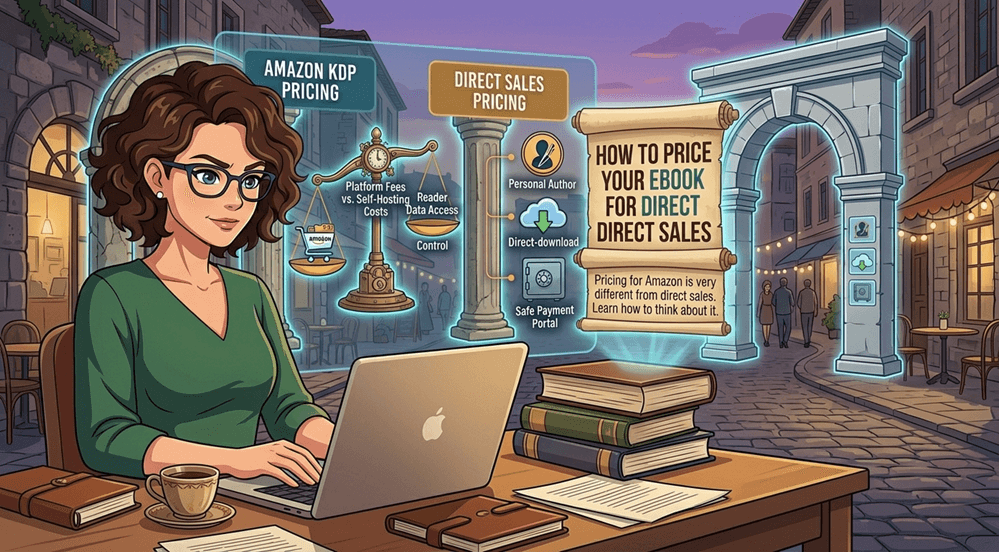
Why eBook Pricing for Direct Sales Is Different
If you have been selling on Amazon, you already have a pricing strategy — even if you have never thought of it that way. Amazon's royalty structure essentially tells you where to price: books between $2.99 and $12.99 earn 70%, while books below or above that range drop to 35%. Most authors cluster their pricing around these thresholds as a result.
Direct sales change the calculation entirely. When you sell from your own website, there is no royalty tier to optimise around, no algorithm to please, and no race to the bottom against thousands of competing titles. You are in control — and that changes what good pricing looks like.
This guide covers how to price your eBook for direct sales in a way that maximises your income, respects your readers, and builds a sustainable author business.
The Maths: Why Direct Sales Pricing Can Be Higher
On Amazon at $4.99, after the 70% royalty and a typical delivery fee, you earn approximately $3.40 per sale. On your own website at the same price, after a 10% platform fee and Stripe processing costs, you earn approximately $4.35 per sale. That is a 28% increase in earnings per copy at identical pricing.
But here is where it gets more interesting. Because you are not competing on Amazon's search results page — where readers compare you against dozens of similar titles side by side — you are not subject to the same price pressure. Your readers have already found you. They came to your website. They are interested in you specifically.
This changes the psychology of the purchase. A reader who seeks you out directly is demonstrably more engaged than a browser clicking through Amazon search results. Engaged readers are less price-sensitive. They are buying your book, not whichever book happens to be cheapest in the category.
Principles for Pricing Your eBook Directly
Price Your Work at Its Value, Not Its Category Average
The most common pricing mistake authors make is benchmarking their price against the cheapest titles in their genre on Amazon. On Amazon, this logic has some merit — discoverability algorithms favour lower-priced books in some contexts. In your own store, it is self-defeating.
Consider what your book is worth to the reader who buys it, not what the lowest-priced competitor charges. A well-crafted thriller that keeps a reader up until 3am is worth more than $0.99. A practical non-fiction guide that helps an author build their business has tangible value that a price point should reflect.
Test Higher Price Points Than You Think Are Appropriate
Most authors underprice. Studies of direct-to-consumer digital product sales consistently show that conversion rates do not drop proportionally with price increases — often a book priced at $7.99 sells nearly as many copies as the same book at $3.99, with dramatically higher revenue per sale.
If you are currently selling at $2.99 on Amazon, test $4.99 or $5.99 in your direct store. Monitor conversions. You may find that your engaged direct buyers respond almost identically, and your per-sale income increases significantly.
Use Direct Sales for Formats and Bundles Amazon Cannot Match
One of the most powerful pricing strategies for direct sales is the bundle. Readers who love your work want more of it — a complete series bundle, a duology, or a combination of your book and exclusive bonus content is genuinely difficult for Amazon to replicate and offers strong value justification for higher pricing.
A series of three books that individually sell at $4.99 each might bundle at $12.99 directly — giving readers a meaningful saving while your per-title equivalent revenue stays healthy. Amazon does not support multi-book bundles natively. Your direct store does.
Practical Price Points to Consider
Short Fiction and Novellas (up to 40,000 words)
For shorter works, $2.99 to $4.99 is a reasonable range for direct sales. Below $2.99 you are leaving money on the table; above $5.99 without established readership may create friction. If the work is part of a series, consider pricing it lower as a reader acquisition tool — the goal is getting readers into the series rather than maximising margin on the entry point.
Full-Length Novels (40,000 to 100,000 words)
$4.99 to $8.99 is a strong range for full-length fiction in direct sales. This is above the Amazon standard, which is intentional — your direct buyers are your most engaged readers and the pricing should reflect that. $6.99 and $7.99 are particularly effective price points that feel premium without being prohibitive.
Non-Fiction and Practical Guides
Non-fiction commands higher prices because it offers tangible, measurable value to the reader. $9.99 to $19.99 is entirely reasonable for a well-researched, practical guide — particularly one that solves a specific, real problem. Authors are often surprised by how little resistance they face at these price points when the book delivers on its promise.
Premium Editions and Signed Copies
For signed digital editions, exclusive annotated versions, or books bundled with bonus content like author notes, deleted scenes, or companion materials, pricing at 20 to 30 percent above your standard price is reasonable and frequently well-received by loyal readers.
Dynamic Pricing Strategies
Launch Pricing
Consider a time-limited launch price for direct buyers — available for the first week or two after release. This rewards your most engaged readers with a small discount and creates urgency. After the launch window closes, the price returns to standard. A typical structure might be $4.99 at launch, rising to $6.99 after two weeks.
Newsletter Exclusive Pricing
Your newsletter subscribers are your warmest audience. A subscriber-only discount code — delivered via email, not posted publicly — lets you reward them with preferential pricing while keeping your public storefront price intact. This is a powerful retention tool and drives list growth as word spreads that your subscribers get better deals.
Backlist and Evergreen Pricing
Older books in your catalogue benefit from stable, sustainable pricing. Resist the temptation to permanently discount backlist titles. Instead, run time-limited promotions — a weekend sale, a birthday deal — that create urgency and a reason to act now rather than leaving the book in a read-later pile.
What Not to Do
- Do not race to free. Free works as a promotional tool for the first book in a series, but permanently free pricing devalues your work and attracts readers who are less likely to buy your next book.
- Do not apologise for your prices. Authors who add defensive copy like "only $4.99!" signal insecurity. State your price clearly and let the book description do the work of justifying it.
- Do not change prices constantly. Frequent price changes erode reader trust. Set a considered price, test it over a meaningful period, and adjust only when you have sufficient data.
The Right Price Is the One That Reflects Your Work's Worth
Pricing is not just arithmetic. It is a signal to readers about how much you value your own work. Authors who price confidently — who treat their books as the valuable creative products they are — tend to attract readers who feel the same way.
Direct sales give you the freedom to price your eBooks at what they are genuinely worth, without the structural pressures of Amazon's marketplace. Use that freedom thoughtfully, test what works for your audience, and remember that the reader who finds you directly is already predisposed to buy. Price accordingly.
Further Reading
· Ready to start your business? ·
Own your author business starting today
Keep 100% of every sale and own every reader relationship — no middleman.
Get Started Free