Beyond Social Media: Why Every Author Needs a Website in 2026
If you are relying solely on social media to build your author platform, you are building your digital house on rented land. In 2026, an author website is the single most important asset you can own to future-proof your career, sell directly to readers, and protect your audience from shifting algorithms.
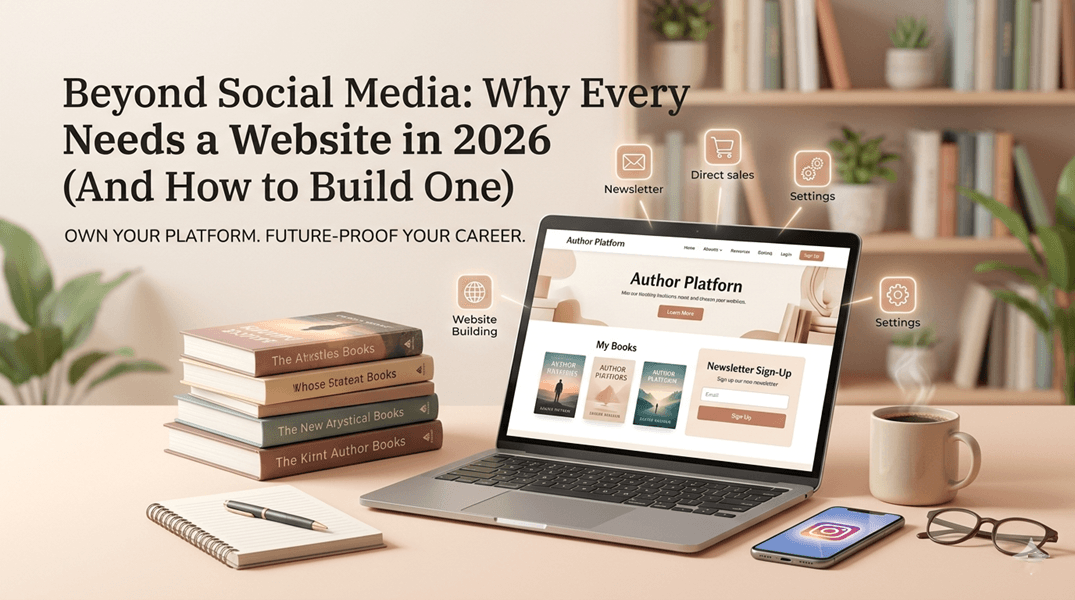
Beyond Social Media: Why Every Author Needs a Website in 2026
Let’s be honest: the digital landscape for authors has gotten a little chaotic lately.
One week, everyone is telling you to dance on TikTok to sell books. The next, a platform changes its algorithm, and suddenly your posts are reaching a fraction of your followers. If you’re relying solely on social media to build your author platform, you’re building your house on rented land — and the rent keeps going up.
In 2026, the publishing world moves faster than ever. AI‑driven search, shifting social trends, and the explosive rise of direct‑to‑consumer (D2C) sales have fundamentally changed how readers discover and buy books. According to HubSpot’s 2026 State of Marketing Report, 61% of marketers believe we’re experiencing the biggest disruption in 20 years due to AI . That disruption affects authors just as much as brands.
The single most important asset you can own as a writer isn’t a viral video — it’s your author website.
Below is a comprehensive, research‑backed guide to why an author website is non‑negotiable in 2026, and how to build one that actually sells books.
Why Social Media Isn’t Enough Anymore
Social media is fantastic for discovery and chatting with readers, but it shouldn’t be the final destination. In 2026, the rules of digital engagement have shifted dramatically.
1. You Don’t Own Your Audience
If a platform shuts down tomorrow, you lose your connection to your readers. This isn’t hypothetical — platforms rise and fall constantly. Even stable platforms throttle reach. HubSpot’s 2026 data shows that core channels like social media still matter, but their effectiveness depends heavily on personalization and algorithmic alignment .
2. The Algorithm Tax
Algorithms decide who sees your content. You could have 10,000 followers and reach only 300 of them on a bad day. On your website, you control the narrative, the visibility, and the experience.
3. Distraction Central
On social media, your book announcement competes with:
Cat videos
Political debates
Ads
Viral drama
AI‑generated content flooding feeds
HubSpot reports that audiences are tuning out generic content and seeking more human, authentic spaces like newsletters and long‑form content . Your website is one of the few places where you can create that focused, human‑centered experience.
4 Reasons Your Website Is Your Ultimate 2026 Author Platform
1. Your Website Powers Your Email List — Your Most Valuable Asset
If you take nothing else away from this post, remember this: your email newsletter is your highest‑converting sales tool.
In 2026, as AI‑generated content saturates the internet, consumers are gravitating toward gated, human‑created spaces like newsletters. HubSpot notes that newsletters and gated content are becoming safe havens from AI‑generated noise .
Your website is the home base for:
Newsletter sign‑ups
Reader magnets
Automated onboarding sequences
Segmented email funnels
Social media may introduce you to readers, but your email list keeps them.
2. Direct‑to‑Consumer (D2C) Sales Are Booming
The D2C revolution has officially hit publishing.
More authors than ever are selling:
Ebooks
Audiobooks
Signed paperbacks
Special editions
Merch
Digital extras
Clutch’s 2026 digital marketing report highlights that 71% of consumers expect brands to personalize their shopping experience, and AI‑powered tools make this easier than ever for independent creators .
When you sell directly:
You keep 90–95% of the revenue
You own the customer relationship
You can upsell and cross‑sell
You can build loyalty programs
You can offer bundles and exclusives
Retailers like Amazon take 30–65% of your royalties. Your website takes 0%.
3. Professionalism and Media Readiness
When a literary agent, publisher, podcaster, or reviewer wants to look you up, where do they go?
They Google your name.
A polished website signals:
Professionalism
Credibility
Brand clarity
Media readiness
HubSpot’s 2026 report emphasizes that brand point‑of‑view and trust are now the strongest growth drivers as AI floods the market with generic content . A website is the clearest expression of your brand POV.
Your site becomes your:
Digital business card
Press kit
Portfolio
Home for interviews, reviews, and appearances
No social profile can replace that.
4. Future‑Proofing Against AI Search
Search engines are no longer just search engines — they’re AI assistants.
In 2026:
Half of all consumers use AI‑powered search tools regularly
Google’s AI Overviews now surface structured data directly in results
AI “buyer agents” are beginning to make purchase recommendations on behalf of users
If you don’t have an official website with structured, accurate information, AI may pull outdated or incorrect data from random sources.
Your website trains the algorithms.
The Anatomy of a High‑Converting Author Website
You don’t need a 50‑page digital labyrinth. A stellar author website in 2026 needs only five core elements — but each must be intentional.
1. The Homepage — Your First Impression
Your homepage should:
Hook the reader immediately
Feature your latest release
Include a prominent newsletter sign‑up above the fold
Use clear, mobile‑optimized design
With over 60% of users browsing on mobile, mobile‑first design is essential (inferred from general industry mobile usage trends).
2. The Books Page — Your Money Maker
This page should:
Display your full bibliography
Include covers, blurbs, and formats
Offer retailer links (Amazon, B&N, Kobo, IndieBound)
Include direct‑to‑consumer purchase options
AI‑powered personalization tools can even recommend which book a visitor should start with based on behavior patterns (supported by Clutch’s findings on AI‑powered audience data) .
3. The “About Me” Page — Your Story Matters
Readers want to know:
Who you are
Why you write
What inspires your stories
HubSpot’s 2026 report emphasizes that human‑led creativity and authenticity outperform automation . Your About page is where you show your humanity.
Include:
A professional headshot
A short and long bio
Awards, press mentions, and fun facts
4. The Newsletter Landing Page — Your Conversion Engine
This page should be:
Distraction‑free
Focused on one action: subscribing
Clear about the value readers get
Paired with a compelling reader magnet
This is where your email list grows — and where your long‑term revenue comes from.
5. Contact / Media Kit — Make It Easy to Say Yes
Include:
A simple contact form
High‑res author photos
High‑res book covers
A downloadable press kit
A short bio for interviews
Links to social media
This makes you media‑ready and easy to feature.
How to Build Your Website (Without a Degree in Coding)
In 2026, no‑code website builders make it incredibly easy to launch a professional site.
Below are the top options — and the trade‑offs.
For the Tech‑Averse: Carrd or Squarespace
Carrd: Simple, sleek, budget‑friendly. Great for a minimalist site.
Squarespace: Beautiful templates, easy editing, solid blogging tools.
But most authors outgrow one‑page sites quickly.
For the Budding Entrepreneur: Shopify
If your main goal is selling books, merch, and special editions, Shopify works well.
But:
You don’t fully own customer data
Monthly fees add up
Customization can get expensive
For Maximum Control: WordPress.org
WordPress offers:
Full customization
Thousands of plugins
SEO control
But it has a steeper learning curve, and many authors don’t have time to manage updates, plugins, and security.
Pro Tip for 2026: Optimize for AI Search
According to HubSpot, 40.6% of marketers are updating SEO specifically for AI‑powered search .
To future‑proof your site:
Use structured data (schema)
Keep book metadata accurate
Maintain a clear site hierarchy
Write human‑centered content
Add FAQ sections for AI assistants
AI assistants increasingly rely on structured, official sources — your website should be one of them.
Final Thoughts: Invest in Your Career
Think of your website as your digital home base.
Social media platforms are the cafes and parks where you meet people, but your website is where you invite your truest fans back for a deeper conversation. It’s where you build trust, nurture relationships, and create a long‑term, sustainable writing career.
Don’t wait until your book is finished to build your site. Start now. Connect with early readers. Establish your brand. Future‑proof your career.
Your website is the one piece of digital real estate you truly own — and in 2026, ownership is everything.

Introducing AUTHORLOFT! All your needs for a robust site is ready at your fingertips. www.authorloft.com
Getting Started With Your Author Website Today
The best author websites are not built in a day — but they are started in one. The gap between authors who have a strong digital presence and those who do not is rarely about talent, budget, or technical skill. It is almost always about whether they started early enough and stayed consistent.
If you do not yet have an author website, the most important thing you can do today is claim your space. Register your author domain — ideally your name, or your name plus "author" or "books" if your name is taken — and put something live, even if it is just a homepage and an email signup. A simple, honest page that says who you are and what you write is infinitely more valuable than a blank screen while you wait for conditions to be perfect.
If you already have a site, audit it through the lens of this post. Does your homepage communicate your value clearly in five seconds? Is your email signup prominent and specific? Do your book pages do the job of selling, not just listing? Small improvements to fundamentals consistently outperform adding new pages or features.
Platforms like AuthorLoft are designed to make this straightforward — giving independent authors everything they need in one place without requiring technical expertise or a large budget. Your author website is the one piece of digital real estate you truly own. In a landscape of shifting algorithms and changing platforms, that ownership is your most durable professional asset. Start building it today.
Further Reading
· Ready to start your business? ·
Own your author business starting today
Keep 100% of every sale and own every reader relationship — no middleman.
Get Started Free