Self-Publishing vs. Traditional Publishing: Which Is Right for You?
Both paths can work. Here's an honest comparison of control, speed, royalties, and reach so you can choose the right one for your goals.
2-Minute Summary
Self-publishing gives you full control, higher royalties per sale, and immediate publishing speed, in exchange for handling every task yourself. Traditional publishing offers an advance, wider retail distribution, and editorial support, in exchange for lower royalties, slower timelines, and less control.
Why It Matters
This is one of the first major decisions a new author makes, and it shapes everything downstream — how you market, how much you earn per sale, and how much control you keep over your work.
Benefits of Each Path
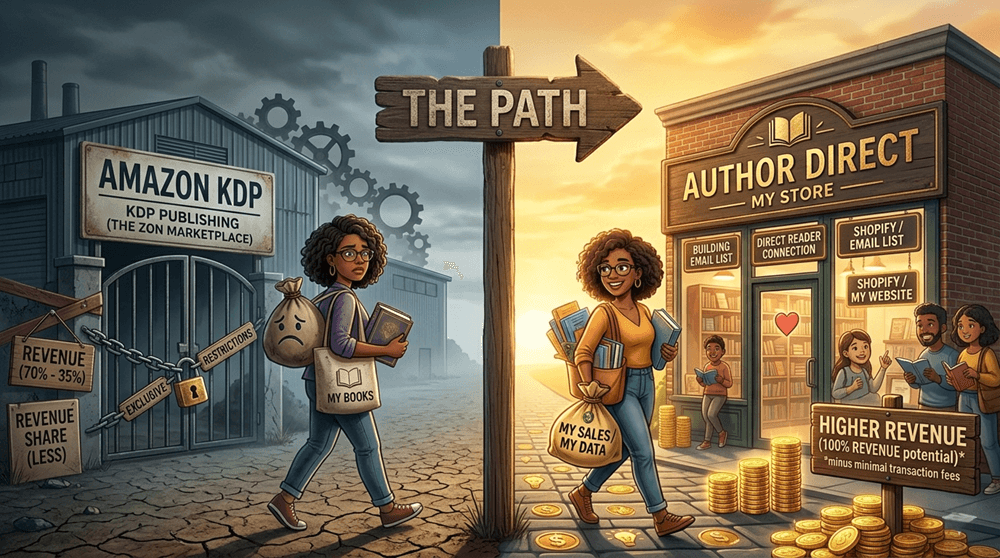
- Self-publishing — higher royalties, full creative control, immediate publishing, direct reader relationships
- Traditional publishing — advance payment, wider physical retail distribution, editorial and marketing support, industry credibility
Step-by-Step: How to Decide
- Consider your timeline — self-publishing can go live in weeks; traditional deals often take 1-2 years from signing to release
- Consider your appetite for business tasks — self-publishing means you handle editing, design, and marketing (or hire for them)
- Consider royalty math — self-published royalties are typically 35-70% vs. traditional's 8-15%, but traditional includes an advance
- Consider distribution needs — if wide physical bookstore presence matters most, traditional has the edge
- Consider control — self-publishing keeps cover, pricing, and release timing entirely in your hands
Common Mistakes
- Assuming self-publishing is "less legitimate" — it is a valid, often more profitable, business model
- Underestimating the time cost of self-publishing's non-writing tasks
- Querying agents for years without considering self-publishing as a parallel or alternative path
Examples
A self-published ebook at $4.99 selling 1,000 copies through Amazon KDP at 70% royalty nets roughly $3,500. A traditionally published book with a $5,000 advance and 10% royalty on a similar retail price needs to sell through the advance before further royalties are paid — the math favors different authors differently depending on their specific numbers and goals.
Frequently Asked Questions
See below.
How AuthorLoft Helps
Whichever path you choose, AuthorLoft gives you an author website, direct sales, and an email list you own — assets that support your career regardless of publishing model.
Frequently Asked Questions
Is self-publishing less legitimate than traditional publishing?
No. Self-publishing is a valid business model that many authors choose deliberately, and it is often more profitable per sale than traditional publishing.
How much faster is self-publishing than traditional?
Self-publishing can go live in weeks once your manuscript is ready. Traditional deals often take 1-2 years from signing to release.
What royalty difference should I expect?
Self-published royalties typically run 35-70% depending on price and platform, compared to roughly 8-15% for traditional publishing, though traditional deals include an upfront advance.
Related Reading

· Build your self-publishing foundation·
Whichever path you choose, start with a website and email list you fully own.
Keep 100 % of every sale and own every reader relationship — no middleman.
Get Started Free